


Understanding Cat Escape Artists: 5 Personality Types and Containment Strategies for Australian Homes

Understanding Cat Escape Artists: 5 Personality Types and Containment Strategies for Australian Homes
Every Escape Attempt Tells a Story About Your Cat
Australian cat owners frequently discover their supposedly contained cats have escaped—often repeatedly. The traditional response is to blame the cat: "My cat is determined," "He's an escape artist," or "She's just too clever." But these explanations miss the underlying truth: not all escape attempts are created equal. Understanding why your specific cat escapes is the foundation for selecting containment solutions that actually work for your household.
Cats are individuals with distinct personalities, physical abilities, and motivations. A climber requires different containment than a jumper. A curious explorer behaves differently than a territorial cat defending against external intruders. By identifying your cat's escape personality type, you can implement containment strategies that address their specific behavior pattern rather than applying generic solutions that fail because they don't match your cat's particular abilities and drives.
Cat Escape Personality Type #1: The Climber
Climbers constitute approximately 40% of escaped domestic cats in Australia. These cats possess natural vertical orientation, strong grip, and problem-solving focus directed upward.
Climber Identification Indicators:
- Scales trees, bookcases, and tall furniture effortlessly indoors
- Shows obsessive interest in fence posts, tree branches, and overhead structures
- Climbs fences by gripping posts and clawing upward (rather than jumping over)
- Often escapes while owner is present—not stealthy or cautious
- Gets stuck in high places regularly and requires rescue
- Exhibits high prey drive focused on birds and airborne activity
Climber Escape Pattern Analysis:
What Climbers Actually Want: Climbers aren't necessarily seeking to escape your property—they're seeking elevated vantage points to hunt, observe, and satisfy territorial instincts. Their escape behavior is opportunistic: they notice a climbable fence post and act on vertical orientation instincts. Australian yards with trees near fences, pergolas, or tall structures are particularly vulnerable because climbers view these as launch points.
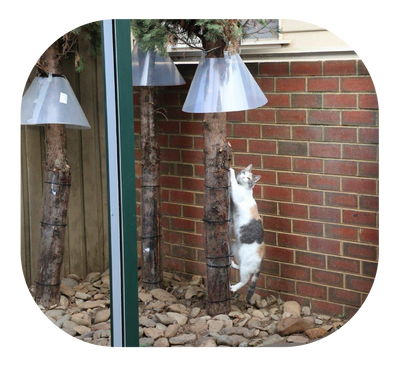
Why Traditional Fencing Fails Climbers: Standard fences up to 2m high are climbable by determined climbers, especially if fence posts provide gripping surfaces or nearby trees offer launching points. Angled toppers and netting don't prevent climbing—they only make it more difficult and may cause injury if the cat attempts to climb over the topper.
Oscillot's Climber Solution:
Oscillot directly addresses climber escape by installing rotating paddle barriers directly atop fence posts. When a climber approaches the top of the fence and attempts to pull themselves over, the rotating paddle system rotates inward, preventing purchase and effectively blocking the climbing path. Climbers can climb to the paddle—but cannot climb past it. The solution is climbing-specific rather than generic barrier-based.
Recommended Setup: 6.2m–12.4m kit (depending on perimeter) with Tree Guard protection ($41.59 AUD) for nearby climbing aids.
Cat Escape Personality Type #2: The Jumper
Jumpers constitute approximately 25% of escaped cats. These athletic cats view fences as height challenges and jump directly over rather than climbing around obstacles.
Jumper Identification Indicators:
- Leaps over obstacles with minimal effort—clearing heights 1.5m+ indoors
- Has narrow, athletic build (often Siamese, Abyssinian, or similar athletic breeds)
- Jumps fences from standing position without climbing or running approach
- Escapes when highly motivated (mating season, territorial disputes, prey sightings)
- Often escapes when owner is present—not cautious, simply athletic
- Returns home frequently (escape isn't necessarily long-term intention)
Jumper Escape Pattern Analysis:
What Jumpers Actually Want: Jumpers seek outdoor territory exploration and (during mating season) access to mates. Their escape is active and deliberate—they assess the fence height, recognize it as surmountable, and jump. Jumpers are often the most dangerous escape type because they demonstrate clear fence assessment and intentional breach behavior.
Why Traditional Solutions Fail Jumpers: Angled toppers and netting can stop some jumpers, but determined athletic cats often learn to navigate these obstacles through repeated attempts. Generic 2.4m fences don't prevent jump-capable cats from clearing them.
Oscillot's Jumper Solution:
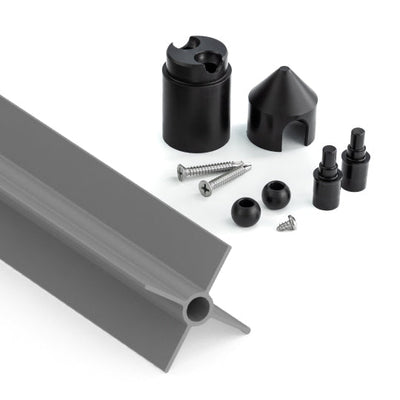
Oscillot exceeds standard fence height by extending protective barriers 20–25cm above fence line. When a jumper approaches fence top with intention to jump, the paddle barrier intercepts their jump trajectory, preventing clearing and returning the cat safely to the property side. Unlike netting (which can entangle and injure), Oscillot's rotating paddle system is non-injurious while being impossibly high to clear.
Recommended Setup: 6.2m–12.4m kit (perimeter coverage) on standard 1.8m fences creates effective 2m+ containment height.
Cat Escape Personality Type #3: The Clever Learner
Clever Learners constitute approximately 15% of escapees—often lower in frequency than climbers or jumpers, but notably persistent in escape attempts.
Clever Learner Identification Indicators:
- Tests fence systematically, appearing to map weak points or gaps
- Adapts behavior after failed escape attempts—doesn't repeat same method
- Shows obsessive focus on specific fence sections or gates
- Often solitary, intelligent breeds (Bengal, Savannah, Maine Coon)
- Escapes when alone or under-stimulated (boredom-driven)
- May exploit mechanical weaknesses (loose brackets, separating fence boards)
Clever Learner Escape Pattern Analysis:
What Clever Learners Actually Want: Mental stimulation and environmental challenge. These cats don't necessarily want to escape—they want to solve the puzzle of escaping. They're entertained by the problem-solving aspect of fence containment, making them extremely dangerous with under-engineered solutions because they view each failed attempt as data toward eventual success.
Why Standard Barriers Fail Clever Learners: Clever learners observe and adapt. They notice that netting stretches under weight and test this weakness repeatedly. They observe humans passing through gates and attempt to follow. They test fence integrity systematically until locating weak points—and traditional fencing has many weak points (loose boards, separated fence panels, gaps near gates).
Oscillot's Clever Learner Solution:
Oscillot's passive mechanical system offers no weak points to exploit and no learning curve—it's a physics-based containment that cannot be outsmarted. A clever cat cannot learn to defeat a rotating paddle system because the physics remains constant regardless of approach method. This removes the entertainment value and problem-solving satisfaction that motivates clever escape attempts.
Recommended Setup: 12.4m–18.6m kit (complete perimeter coverage) to eliminate any "untested section" opportunity.
Cat Escape Personality Type #4: The Social Learner
Social Learners (approximately 10% of escaping cats) escape through observational learning from other cats or by following humans through access points.
Social Learner Identification Indicators:
- Escapes occur primarily when other cats are in yard (learns from observation)
- Multiple cats in same household—often one "leads" others in escape patterns
- Escapes following human passage through gates or doors
- Often anxious or socially bonded cats (follows lead of bolder cats)
- Escape patterns change if lead cat is removed or separated
- More common in multi-cat households or properties adjacent to stray cat populations
Social Learner Escape Pattern Analysis:
What Social Learners Actually Want: Social connection and group behavior replication. These cats don't independently assess and exploit fence vulnerabilities—they follow examples set by other cats. In multi-cat households, one climber or jumper often teaches other cats the escape technique, creating cascading escape problems.
Oscillot's Social Learner Solution:
Because Oscillot creates universal containment preventing any cat—regardless of method—from escaping, it eliminates the demonstration effect. Even if one cat learns another's technique, Oscillot prevents successful escape, breaking the learning chain. This is particularly valuable in multi-cat households where one determined cat would previously teach others escape methods.
Recommended Setup: 9.3m–12.4m kit (full perimeter) covering all potential observation points.
Cat Escape Personality Type #5: The Anxious Escaper
Anxious Escapers (approximately 10% of escapees) flee containment due to stress, anxiety, or fear rather than intentional exploration or territorial needs.
Anxious Escaper Identification Indicators:
- Escapes triggered by specific stressors (loud noises, construction, unfamiliar people)
- Often recent rescues, trauma survivors, or sensitive-temperament cats
- Escape behavior is panicked and disoriented rather than methodical
- May hide outside for extended periods after escaping (fear-driven)
- Escapes more frequent during stressful periods (renovations, new pets/people)
- Responds to anxiety medication or environmental modification with reduced escape attempts
Anxious Escaper Escape Pattern Analysis:
What Anxious Escapers Actually Want: Psychological safety and retreat from perceived threats. These cats don't escape due to containment weakness—they escape because containment stress combines with external stressors, creating panic response.
Oscillot's Anxious Escaper Solution:
Oscillot provides psychological benefit beyond physical containment. Knowing your anxious cat cannot escape—regardless of stress level—allows you to provide enrichment and anxiety-reducing interventions with confidence. Coupled with environmental modifications (shade structures, hiding boxes, vertical enrichment), Oscillot prevents panic-escape incidents while you address underlying anxiety through behavioral or pharmaceutical interventions.
Recommended Setup: 6.2m–12.4m kit (complete coverage) paired with environmental enrichment (trees, hiding structures, shade) to reduce anxiety triggers.
Identifying Your Specific Cat's Escape Type
Most Australian households contain one primary escape type, but multi-cat properties may have 2–3 escape personalities represented. Use this diagnostic approach:
Step 1: Document Escape Behavior
- How does your cat approach the fence? (Climbing, jumping, walking along, testing gaps)
- When do escapes occur? (Specific times, weather, seasons, presence/absence of humans)
- Does escape method change after failures? (Consistent vs. adaptive)
- Is escape paired with other cats' behavior? (Independent vs. following)
Step 2: Video Documentation
Modern phones make escape documentation trivial. Record 10–15 minutes of your cat interacting with the fence. Analyze video to identify personality indicators. This objective documentation is invaluable for identifying true patterns vs. perceived patterns.
Step 3: Consult Professional Assessment (Optional)
If uncertain, Oscillot's Australian installer network includes feline behavior specialists who can assess your specific cat(s) and recommend tailored solutions. Most consultations are complimentary and help ensure you select appropriate kit sizing for your personality-type mix.
Multi-Escape-Type Households
Properties with multiple escape personality types present greater challenges. A household with both a climber and a jumper requires containment addressing both vertical climbing and jump-clearing prevention. The solution is identical regardless: complete Oscillot perimeter coverage addresses all escape types universally.
Recommended approach: Install sufficient kit length to cover 100% of fence perimeter. This eliminates any "weak point" potential and ensures all cats—regardless of individual escape personality—remain safely contained.
Your Path Forward: Matching Solution to Personality
Understanding your cat's escape personality transforms containment from frustrating guesswork to targeted solution selection. Once you identify whether your cat is a climber, jumper, learner, social follower, or anxious escaper, you can select containment that specifically addresses their behavioral pattern.
The right containment solution isn't about restricting your cat—it's about understanding their individual personality and providing safety that matches their specific needs and abilities.



Leave a comment