


Cat Still Escaping After Oscillot Installation: 8 Critical Mistakes and How to Fix Them

Cat Still Escaping After Oscillot Installation: 8 Critical Mistakes and How to Fix Them
Why Your Oscillot Isn't Working (And How to Fix It)
Oscillot systems are virtually 100% effective when properly installed. Yet occasionally, Australian property owners report that their cats continue escaping despite installation. The Oscillot system itself isn't failing—an installation error is creating a bypass point. This guide walks through the eight most common installation mistakes and diagnostic approaches to identify and remedy problems.
The good news: every installation mistake covered here is readily fixable. Most require simple adjustments or component repositioning. Understanding these errors means diagnosing problems quickly and returning your system to full containment effectiveness.
Mistake #1: Incomplete Perimeter Coverage
The Problem:
The most common escape cause: one or more fence sections lack Oscillot protection entirely. Property owners often assume a single escape point represents a system failure, when actually it represents incomplete installation.
Diagnostic Approach:
Visual Inspection Test: Walk your complete perimeter and look for fence sections lacking paddle sets. Mark any "uncovered" sections. Many property owners install Oscillot on back fence only, forgetting side or front sections where cats might escape.
Video Documentation: Set phone camera to record your cat's activity for 20 minutes. Watch video in real-time and pause when your cat approaches fence. Note which section the cat tests. If escape occurs, note precise location.
The Fix:
- Identify exact fence section lacking coverage
- Measure that section's length
- Order additional Oscillot kit matching the section length (available in 1.2m–6.2m increments, $160–$400 AUD)
- Install on the missing section using identical techniques to your original installation
- Test installation: manually rotate paddles on new section; all should rotate smoothly
Mistake #2: Gate Bypass Points
The Problem:
Gates are the most common escape vulnerability. Gaps around gate frames, loose hinges, or gaps where gate meets fence allow cats to slip through or climb over the gate structure itself.
Diagnostic Approach:
Gap Analysis: Inspect all gate frames closely. Shine a light behind the gate—if you can see light through gaps, so can a determined cat. Check:
- Gap between gate bottom and ground
- Gaps on sides where gate meets frame
- Top of gate (does it have padding/protection?)
- Hinge looseness (causes gaps to appear/disappear)
The Fix:
- Bottom gaps: Add rubber weatherstripping or rigid closure below gate (reduce gap to <2cm)
- Side gaps: Tighten hinges; add rubber gaskets if gaps persist
- Gate top: Install Oscillot padding on gate top or extend existing system across gate width
- Gate testing: Close gate and check that it aligns properly with frame
Mistake #3: Paddle Installation Angle Issues
The Problem:
Paddles installed at incorrect angles may not rotate freely or may not extend far enough past fence line to prevent clearing. Common issues: paddles tilted inward (toward fence), rotated too far outward, or installed upside-down.
Diagnostic Approach:
Angle Verification Test: Manually lift paddle assembly and observe its rotation. It should rotate smoothly through 180° from vertical (closed) to horizontal (open). If rotation feels binding or limited, angle may be incorrect.
Visual Check: Paddle in neutral position should extend 20–25cm beyond fence top at right angle to fence line. If paddles angle downward or upward significantly, they're installed incorrectly.
The Fix:
- Loosen bracket fasteners (not fully removed)
- Adjust bracket mounting angle to ensure paddle hangs vertically when at rest
- Verify paddle extends perpendicular to fence line
- Retighten fasteners (ensure full tightness—loose brackets cause angle drift)
- Re-test manual rotation for smooth full-range movement
Mistake #4: Excessive Bracket Spacing
The Problem:
Brackets spaced more than 30cm apart create gaps between paddle sets. Even a small gap (5–10cm) allows an athletic cat to slip through or jump over the partial barrier.
Diagnostic Approach:
Spacing Measurement Test: Measure distance between adjacent brackets. Standard spacing should be 20–25cm. If spacing exceeds 30cm, gaps exist that clever cats exploit.
Visual Gap Test: Look at bracket spacing from above (perspective from fence top). Can you see "gap" between paddle sets where a cat could slip through? If yes, spacing is excessive.
The Fix:
- Identify all excessive spacing locations (typically 5–10 locations)
- Order additional paddle sets ($32–$40 AUD per set)
- Install additional sets at midpoint between existing brackets, reducing spacing to 12–15cm
- Re-test: confirm no visible gaps from fence-top perspective
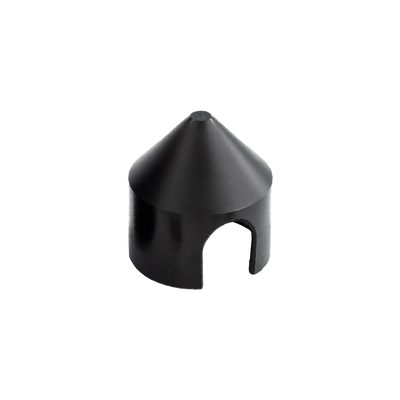
Mistake #5: Loose or Missing Post Caps
The Problem:
Post caps that are loose or missing create hard, graspable edges where cats can pull themselves up and gain leverage to escape. A missing post cap turns the post top into a climbing aid.
Diagnostic Approach:
Cap Inspection: Walk perimeter and inspect each post top. Caps should be securely seated with no movement when pressed. If caps are loose or missing, they're escape facilitators.
Touch Test: Press on each cap firmly. It should not shift, rotate, or come loose. If movement exists, cap needs tightening or replacement.
The Fix:
- Loose caps: Remove and reseat firmly; replace cap screws/fasteners if worn
- Missing caps: Order replacement caps ($5.90 AUD each) and install immediately
- Worn caps: Replace if cracks, brittleness, or damage appears (compromises function)
- Verification: Confirm all posts have caps after fix; no bare post tops exposed
Mistake #6: Insufficient Paddle Height Above Fence Line
The Problem:
Paddles must extend at least 20–25cm above fence line to prevent cats from clearing the barrier. Installation errors may result in paddles extending only 10–15cm, allowing athletic cats to jump over.
Diagnostic Approach:
Height Measurement: Measure vertical distance from fence top to paddle tip (with paddle hanging vertical). Should measure 20–25cm. If less than 15cm, height is insufficient.
Jump Test Observation: Watch your cat approach fence. If cat easily clears the paddle barrier with visible margin, paddle height is insufficient.
The Fix:
- Check bracket mounting height (bracket should position paddle for 20–25cm extension)
- If bracket is mounted too low, loosen and remount higher on post
- Verify paddle length matches specification (replacement paddles if original is shortened)
- Re-measure and confirm 20–25cm extension achieved
Mistake #7: Tree or Structure Launch Points
The Problem:
Cats use nearby trees, pergolas, or other structures as launch points for jumping over fences. A tree branch 0.5m above fence line creates a launching platform for athletic cats, allowing them to jump higher than they could from ground level.
Diagnostic Approach:
Environmental Assessment: Walk perimeter and identify any structures (trees, pergolas, sheds, rock piles) within 1.5m of fence that could serve as climbing aids or jump launch points.
Video Analysis: Review escape video footage. Does cat climb/jump onto nearby structure before attempting fence escape? If yes, structure is facilitating escape.
The Fix:
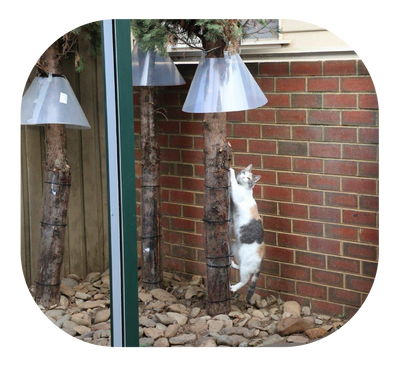
- Trees near fence: Trim branches extending over fence or within 1m of fence line. Use Oscillot Tree Guard ($41.59 AUD) to prevent tree climbing entirely.
- Pergolas/structures: Relocate if possible, or wrap with smooth plastic to prevent climbing
- Rock piles: Level or relocate; prevent cats from climbing onto elevation near fence
- Furniture/objects: Remove objects near fence that cats can climb
Mistake #8: Binding or Sticky Bearing Assemblies
The Problem:
Paddles that don't rotate freely become less effective at creating barrier resistance. A binding paddle that's difficult to rotate manually is failing to rotate properly when cats apply force, allowing determined cats to push or climb past the obstacle.
Diagnostic Approach:
Manual Rotation Test: Grasp paddle assembly and attempt smooth manual rotation through full 180° range. Should rotate with minimal resistance (light hand pressure is normal). If rotation feels sticky, grinding, or binding, bearing assembly has issue.
Debris Inspection: Inspect bearing assembly for leaves, dirt, or debris accumulation. Australian climate's high wind/pollen can clog bearings.
The Fix:
- Debris cleaning: Remove visible debris using brush or compressed air. Test rotation again.
- Bearing lubrication: Apply light silicone spray to bearing assembly (minimal amount—use sparingly)
- Fastener tightness: Verify all bracket fasteners are snug; loose bolts cause binding
- Bearing replacement: If stiffness persists after cleaning/lubrication, bearing assembly may be defective. Order replacement bearing kit ($25–$35 AUD) and follow installation instructions.
Diagnostic Decision Tree
Follow This Process to Identify Your Specific Problem:
- Document escape behavior: When/where do escapes occur? Video record if possible.
- Check perimeter coverage: Does every fence section have paddles? → If no → Mistake #1 (incomplete coverage)
- Inspect gate integrity: Are gate gaps visible? → If yes → Mistake #2 (gate bypass)
- Test paddle rotation: Do all paddles rotate smoothly? → If no → Mistake #4 or #8 (spacing or binding)
- Measure paddle extension: Is paddle height 20–25cm above fence? → If no → Mistake #6 (insufficient height)
- Verify post caps: Are all post caps present and tight? → If no → Mistake #5 (missing caps)
- Assess launch points: Are trees/structures near fence usable for climbing? → If yes → Mistake #7 (launch points)
- Confirm paddle angle: Do paddles extend perpendicular to fence? → If no → Mistake #3 (angle issue)
Getting Professional Diagnostic Help
If diagnosis remains unclear after self-assessment, Oscillot's Australian technical team offers free consultation:
- Email support: support@oscillot.com.au — attach photos/videos of escape behavior
- Phone consultation: Describe escape behavior; technicians provide diagnostic guidance
- On-site inspection (optional): Professional installer visits property to identify issues ($150–$200 AUD) — most issues fixable same-day
Prevention: Installation Best Practices
Avoiding these mistakes during installation ensures you never encounter escape problems:
- Measure your complete perimeter before ordering; confirm kit size covers 100% of fence
- Use spacing template during installation (Oscillot provides marking guide)
- Test every paddle for smooth rotation before fastening brackets permanently
- Measure paddle extension height during installation; adjust brackets if needed
- Trim tree branches during installation; use Tree Guard for adjacent trees
- Verify all post caps are installed and secure before declaring installation complete
- Document installation with photos for warranty records
After-Fix Verification
Once you've addressed the identified mistake(s), verification is critical:
- Manually test all paddles through full rotation range (should all rotate smoothly)
- Walk perimeter visually confirming no gaps between paddle sets
- Measure paddle height at several points (should all be 20–25cm)
- Inspect all post caps (present and secure)
- Confirm gate gaps are sealed
- Monitor cat behavior for 2–3 weeks; no escape attempts indicates successful fix
Your Path to Escape-Free Containment
Oscillot systems are virtually fail-proof when properly installed. If your cat continues escaping, an installation error is almost certainly the cause—and now you have the diagnostic tools to identify and fix it. Most fixes require simple adjustments or inexpensive component additions, and you can complete most remedies yourself.
Contact Oscillot Australian Support
Every installation mistake has a straightforward solution. Your cat's escape doesn't represent system failure—it represents a fixable installation detail that needs attention.



Leave a comment