


Installing Oscillot on Curved Fences: Complete Technical Guide for Australian Properties

Installing Oscillot on Curved Fences: Complete Technical Guide for Australian Properties
Non-Standard Fence Geometry Doesn't Mean Non-Standard Results
Many Australian properties feature curved fences, angled corners, sloped terrain, or other non-rectangular fence layouts. Property owners with these features often believe Oscillot's paddle-based system requires straight fence sections and level ground. This misconception leads to missed opportunities—Oscillot actually accommodates non-standard geometry through thoughtful bracket spacing and component modification. This comprehensive guide walks through curved fence installations and complex geometry handling.
Understanding Curved Fence Dynamics
Oscillot's bracket system mounts to existing fence posts, and bracket spacing fundamentally affects paddle rotation mechanics. A paddle set installed 25cm apart on straight sections may require 15–20cm spacing on sharp curves (radius under 1 metre), while gentle curves (radius 2+ metres) tolerate standard 25cm spacing. The core principle: paddle sets must maintain sufficient proximity to create continuous barrier, but excessive proximity creates binding and rotation resistance.
Bracket Spacing By Curve Radius:
- Straight sections or gentle curves (radius 2m+): 20–25cm spacing standard
- Moderate curves (radius 1–2m): 15–20cm spacing recommended
- Sharp curves (radius under 1m): 10–15cm spacing required
- L-shaped corners (90° angles): Special bracket configuration needed (consult support)
Tighter spacing doesn't compromise paddle function—it ensures smooth rotation despite changed geometry. The trade-off is component quantity: sharp curves require more brackets and padding sets, increasing material cost but maintaining full system functionality.
Measuring Curved Fence Sections: The Foundation Step
Step 1: Determine Curve Radius
For gentle curves, radius estimation is adequate: visually assess the curve and estimate the arc's circular radius. For sharp curves requiring precise measurement, use the three-point method:
- Mark three points on the fence line (points A, B, C along the curve)
- Measure perpendicular distances from fence line to a baseline
- Calculate radius using these three points (basic geometry or online calculator)
For most Australian residential properties, visual estimation suffices. Severe curves (radius under 0.5m) warrant professional measurement before installation.
Step 2: Linear Distance vs. Curved Distance
Critical measurement error: Curved sections measure longer than straight-line distance between endpoints. A curved section with 2-metre straight-line distance might measure 2.4–2.8 metres along the curve. Always measure along the fence itself, not straight-line property distance.
Method: Use a long measuring tape along the fence itself (account for actual fence geometry), or count post spacing (if posts are standardised spacing) and calculate accordingly.
Component Adjustments for Curved Installations
Oscillot Components in Curved Geometry:
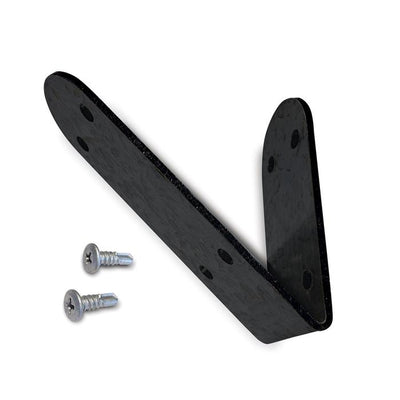
- Bracket angles: Standard brackets work on curves but may require slight bending for sharp curves (acceptable within design limits)
- Paddle sets: Function identically on curves—rotation mechanism is radius-independent
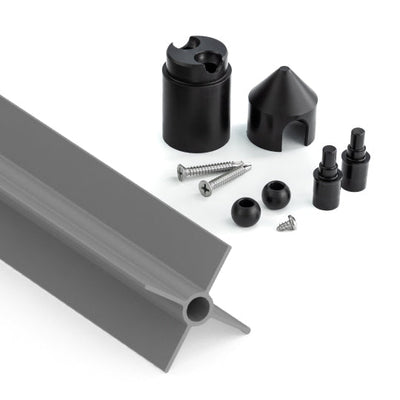
- Post caps: May require offset positioning on angled sections (consult support for extreme angles)
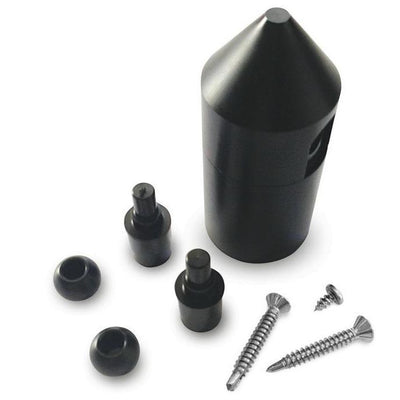
- Axle pins: Standard components; no radius-specific modifications needed
Oscillot's bracket design accommodates up to 15° angle variation without modification. Beyond this, contact Oscillot's Australian technical team for custom bracket guidance ($0 support cost, part of warranty).
Real-World Installation Example: L-Shaped Property
Property Layout: 2-storey suburban home with L-shaped fence line
- Side 1: 8.5 metres straight section, standard 1.8m fence
- Corner: Sharp 90° angle (radius ~0.3m turn)
- Side 2: 6.2 metres with sloped terrain (downslope ~0.5m elevation change)
- Side 3: 5 metres with one tree encroachment requiring curve
Measurement Breakdown:
- Side 1 (8.5m straight): Standard 25cm spacing = 34 bracket pairs + paddle sets
- Corner (sharp 90° angle): Special configuration = 6 additional bracket pairs at 10cm spacing
- Side 2 (6.2m with slope): Standard spacing with height adjustment per bracket = 25 bracket pairs
- Side 3 (5m with tree curve): Moderate curve (radius ~1.2m) = 20 bracket pairs at 15cm average spacing
Total Required: ~85 bracket pairs + ~85 paddle sets (equivalent to approximately 18.6–24.8m kit)
Sloped Terrain: Height Adjustment Strategies
Australian properties often feature sloped terrain. Oscillot accommodates slopes through bracket height adjustment—each bracket mounted slightly higher than the previous one to maintain consistent paddle height above fence line.
Slope Calculation for Even Paddle Height:
- Measure total elevation change: 0.5m downslope over 6.2m distance = 8% gradient
- Calculate per-bracket height increase: 0.5m ÷ 25 brackets = 2cm per bracket
- Implementation: Use shim brackets or offset mounts increasing 2cm per bracket (maintain even paddle height)
Alternative approach: Use standard bracket mounting and accept natural paddle height variation (paddle set maintains 20–25cm extension above fence line despite slope). This is acceptable for most installations—the paddle barrier remains effective even with ±5cm height variation.
Tree Proximity and Cutting Requirements
Australian backyards frequently include trees near fence lines. Overhanging branches can obstruct paddle rotation, so trimming is often necessary.
Tree Branch Clearance Requirements:
- Minimum clearance above paddle: 30cm clear space for paddle rotation
- Lateral clearance: 20cm clear space on each side of fence line
- Trim branches below these specifications to ensure mechanical operation
- Do NOT permanently remove trees—only remove specific branches impacting operation
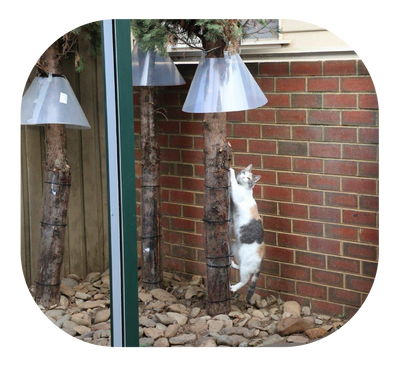
Use Oscillot's proprietary Tree Guard protection ($41.59 AUD) to prevent cats climbing trees adjacent to fence. Tree guards wrap around trunk and prevent climbing, eliminating the "launch point" for climbing-oriented cats.
Multi-Level Fence Heights: Managing Variation
Some Australian properties feature varying fence heights within the same perimeter (1.8m on one side, 2m on another). Oscillot accommodates this through proportional bracket adjustment:
- 1.8m fence section: Standard bracket mounting, paddle extends 20–25cm above fence top
- 2m fence section: Slightly longer paddle set or extended bracket mounting
- Transition between sections: Gradual bracket height adjustment prevents abrupt height jumps
This creates seamless protection regardless of fence height variation.
Corner Installation Techniques
90° Corner Installation Steps:
- Pre-installation measurement: Mark bracket positions on both fence sections leading into corner (15cm spacing for sharp corners)
- Corner post preparation: Verify post is solid and firmly anchored (corners experience stress)
- Bracket mounting at 45° angle: Mount corner bracket at 45° angle bisecting the two fence lines
- Paddle set orientation: Orient paddle to face external corner (preventing cats from accessing corner pocket)
- Binding clearance test: Manually rotate paddle through full motion—ensure no binding at angle extremes
- Adjacent bracket spacing: Continue 15cm spacing for 2–3 brackets on each side of corner (transitions gradually back to 25cm standard)
Curved Section Material Selection
Fence Type Considerations for Curves:
- Timber fences: Most common in Australia; curves typically created through flexible timber boards. Standard Oscillot installation applies. Minor curvature (radius 2m+) requires no modification.
- Colorbond/metal fences: Curved sections may be pre-fabricated curved panels. Bracket mounting to curved metal may require custom positioning (consult support).
- Vinyl fences: Can accommodate gentle curves. Avoid sharp curve vinyl sections without professional consultation.
- Mixed fences (segmented): Some Australian properties use straight panels joined at angles. Install Oscillot per panel (accounting for angle changes at joints).
Technical Specifications for Complex Installations
| Scenario | Radius | Bracket Spacing | Estimated Kit Size Multiplier | Additional Cost |
|---|---|---|---|---|
| Straight sections | N/A | 25cm | 1.0x | $0 AUD |
| Gentle curve | 2m+ | 20–25cm | 1.05–1.10x | $40–$80 AUD |
| Moderate curve | 1–2m | 15–20cm | 1.15–1.25x | $120–$200 AUD |
| Sharp curve | <1m | 10–15cm | 1.30–1.40x | $240–$320 AUD |
| 90° corner | ~0.3m | 10–15cm | +0.20–0.30x | $160–$240 AUD per corner |
Common Curved Installation Challenges
Challenge: Paddle Binding on Sharp Curves
Symptom: Paddles rotate stiffly or don't rotate smoothly on curved sections. Solution: Reduce bracket spacing to 10–15cm or adjust bracket angles. Contact Oscillot support if issue persists.
Challenge: Uneven Paddle Height on Slopes
Symptom: Paddles at different heights along sloped section. Solution: Accept natural height variation if under 5cm (functionally acceptable) or implement shim-based height adjustment for uniformity.
Challenge: Tree Branches Blocking Paddle Rotation
Symptom: Paddles catch on branches or rotate incompletely. Solution: Trim branches creating obstruction. Oscillot Tree Guard prevents cats using trees as launch points.
Curved Installation Support and Professional Options
Oscillot's Australian installer network includes specialists experienced with complex curved installations. While self-installation is feasible for simple curves, sharp curves or multi-curve properties warrant professional guidance:
- Free design consultation: Email property measurements and fence photos; Oscillot provides component recommendations ($0 cost)
- Professional installation: $320–$640 AUD depending on complexity
- Curved fence troubleshooting: Post-installation support if binding or height issues emerge ($0 cost under warranty)
Measuring Your Curved Fence
Oscillot's online fence calculator accommodates complex geometry: input straight sections, curves with radii, slope information, and corner angles. The tool calculates exact component requirements and cost estimates in AUD.
Your Curved Fence Installation Success
Non-standard fence geometry isn't a barrier to Oscillot installation—it's a design variation requiring thoughtful bracket spacing and component selection. By understanding curve dynamics and adjusting bracket spacing accordingly, your curved fence receives protection identical to straight sections.
Start Your Curved Fence Installation
Curved fences, slopes, and complex property geometry are entirely compatible with Oscillot protection. Your non-standard property layout doesn't compromise containment reliability.



Leave a comment